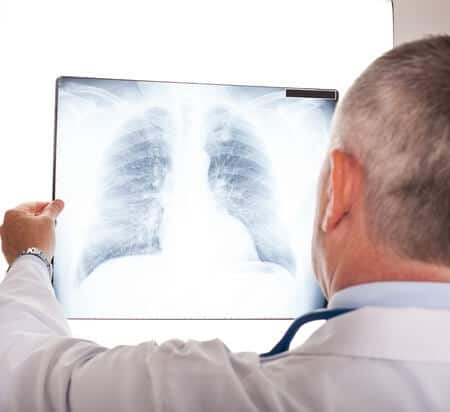
This case involves a sixty-five-year-old male who was admitted to the hospital for congestive heart failure. His presenting symptoms included progressive shortness of breath, orthopnea, paroxysmal nocturnal dyspnea, and lower extremity swelling. During the patient’s stay, a five-centimeter mass was found on the left posterior upper lung lobe, along with a collection of fluid along the right lung base that was consistent with a pleural effusion. The radiologist recommended a biopsy because the combination of findings was highly suspicious for malignancy. A CT-guided percutaneous biopsy was performed using a posterior approach, and it was conducted without incident. Shortly after the patient was transferred to the recovery area, however, he went into cardiopulmonary arrest. Because of this, ACLS protocols were initiated. A chest tube was placed and over 4000cc of dark red blood was evacuated. Three units of blood were transfused during the code but the patient did not survive.
Question(s) For Expert Witness
- 1. Are the complications described in this summary likely the result of inadequate technique?
Expert Witness Response E-005926
There is no real evidence here to suggest that this complication was due to inadequate surgical technique. As with any surgical procedure, complications are possible. Fortunately, major complications due to thin needle aspiration biopsies are fairly uncommon, and when complications do occur, they are generally mild. Nonetheless, if the patient was not on anti-coagulants and the labs values were normal before the procedure then there are no real prior predictors of this rare complication. The medical management that took place once the complication was revealed, however, may be investigated further as this person should not have passed.
Contact this expert witness
Related Posts
This case involves a fifty-two-year-old male patient. He had a history of progressive left nasal obstruction and foreign body sensation that developed acutely. The patient underwent several endoscopic procedures to evaluate for possible obstruction. An endonasal excision of a left…
This case involves a fifty-five-year-old male who presented to his primary care physician with complaints of worsening chest pain, chest pressure, and shortness of breath. Electrocardiogram results were abnormal and the PCP referred the patient to a cardiology group for…