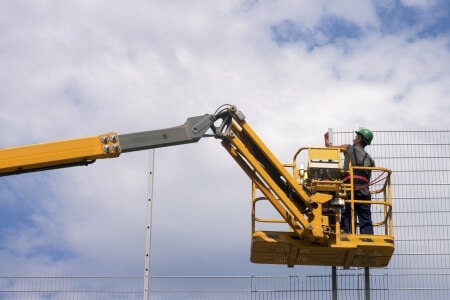
This case involves a commercial painter who was severely and permanently injured when a construction lift he was working on tipped over. At the time of the incident in question, the worker was using the lift to access the side of a large commercial structure, which he was covering with a protective coat of paint. It was noted that the machine lacked stabilization struts, despite the fact that it was designed specifically for use at significant heights. The worker extended the lift to near its maximum recommended height when it suddenly tipped over, causing serious injuries.
Question(s) For Expert Witness
- 1. Please describe your experience in designing and/or testing industrial aerial lifts.
-
2. What design features could be used to prevent aerial lifts from flipping?
Expert Witness Response E-007551
I own a construction equipment inspection company and have inspected several aerial lifts. Hydraulic outriggers/stabilizers are what are used to prevent aerial lifts from flipping. “Better” aerial lifts have these in place at the time of purchase. For background, these outriggers/stabilizers come with the equipment itself. They are not purchased as an addition. They’re approximately 4 feet long and help stabilize the machine when it is on uneven ground or is bearing a considerable amount of weight. Most machinery involving height such as aerial lifts have outriggers or stabilizers. This model does not have such an outrigger or stabilizer and in my opinion, this is a major design flaw. This model does have a counterweight that’s intended to off-set the balance of the machine, but that is not sufficient to balance the machine, particularly considering that in reality, the machines are often on uneven ground.
Contact this expert witness
Related Posts
This case involves a female patient in her mid-thirties who presented to the emergency room with persistent abdominal pain and gastric distress. A CT scan was ordered and several possible causes were suggested – the patient was discharged with a…
This case involves the death of a middle-aged man who had recently undergone gastric bypass surgery from an internal hernia. The man had called the office of his gastric surgeon and reported a severe constipation problem. Despite his serious complaints,…